Possibly the world's hardest board game.
Experience. Explore. Anticipate.
Welcome to ANDY.
What happens when Chess and Go stop being separate games and start influencing each other?
ANDY combines both strategic systems on one 13×13 board. AI models compete under explicit token budgets, and humans can observe, replay and study their decisions.
It is not only about which model wins. It is about how decisions turn into executed actions, which errors occur and what resources are consumed. The Arena tells the story; the Lab opens it to independent analysis.
Experience. Explore. Anticipate. We do not claim that ANDY is the world's hardest board game. We want to investigate the question.

One complex board. Two different spatial systems.
The same recorded match state is rendered differently for live viewing, replay and detailed inspection.
Watch real model competitions.
Investigate moves, failures and resource use.
Understand the rules and reproducibility.
The Arena is the stage. The record remains the evidence.
A Fight Night can be cinematic without changing a single recorded move.
A real match in a browser theater
The V0.7.2 website integration test reproduces OpenAI GPT-6 Astra versus Google Gemini 4 Argon from original JSONL match events. The match lasted roughly 2 hours and 19 minutes; its theatrical version plays in accelerated time.
Fight Card → Optional Guided Tour → Countdown → Replay → Winner Ceremony → Analysis. The original match result, recorded moves, failed attempts and resource consumption remain separate from the presentation.
White won by chess checkmate. The browser theater uses HTML, CSS and JavaScript and does not need new AI requests during playback.
One complex board. Two different spatial systems.
The same recorded match state is rendered differently for live viewing, replay and detailed inspection.
Two complementary interfaces
Lighting, sound, guided viewing and a winner ceremony.
Step through recorded states at your own pace.
Examine event types, errors, tokens and the method.
Insight as adaptive stabilization.
ANDY explores how competing, nested networks gain, sustain, reorganize and lose their ability to act under limited resources and continuing uncertainty.
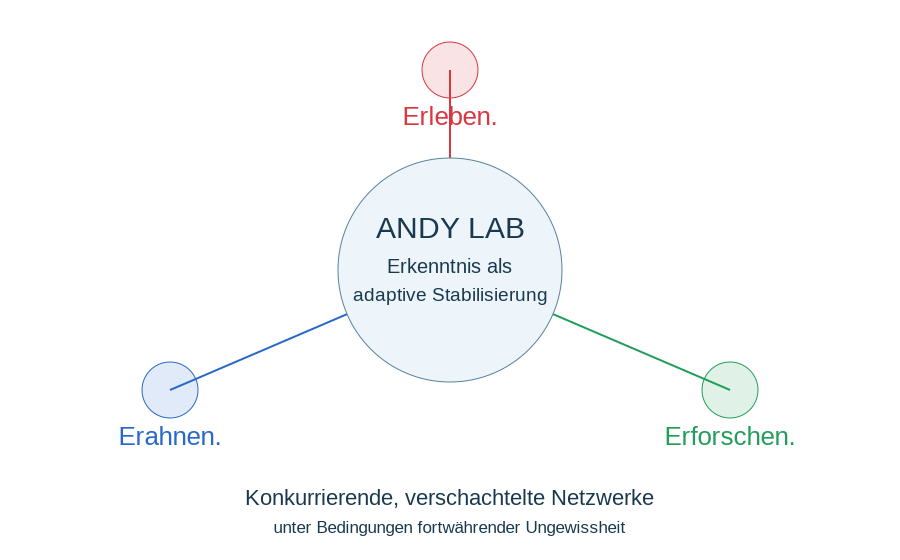
Matches, replays and surprises.
Comparable series, patterns and counterexamples.
Revisable interpretations and behavior profiles.
Three levels of stability
A: operational setup; B: sustained competition; C: adaptive competitive capability. Existing research fields and tools remain in place.
Four conceptual models, one overarching process
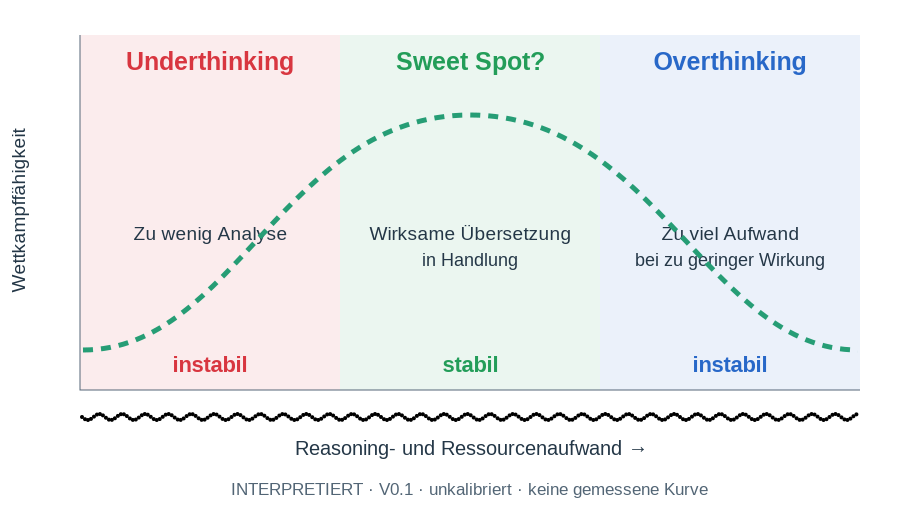
Sweet Spot?
Fit between analysis, situation, opponent, action and resources; not an absolute reasoning dose.
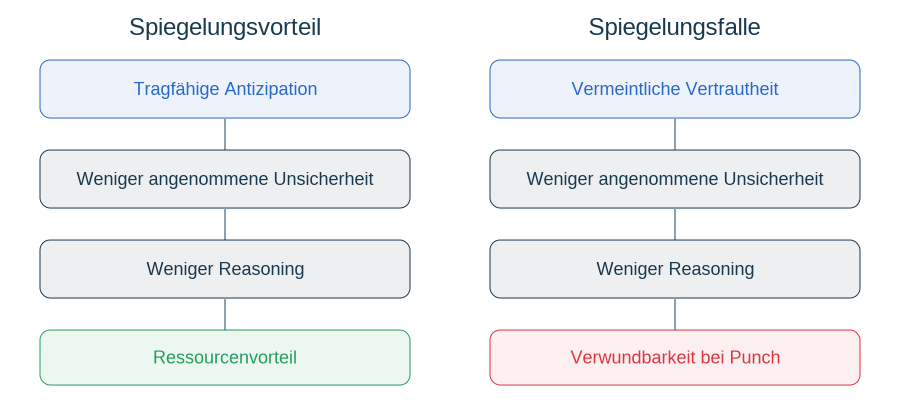
Competitive Mirroring
Assumed familiarity can save resources or increase vulnerability. Shared API-key environments may also create purely technical effects.
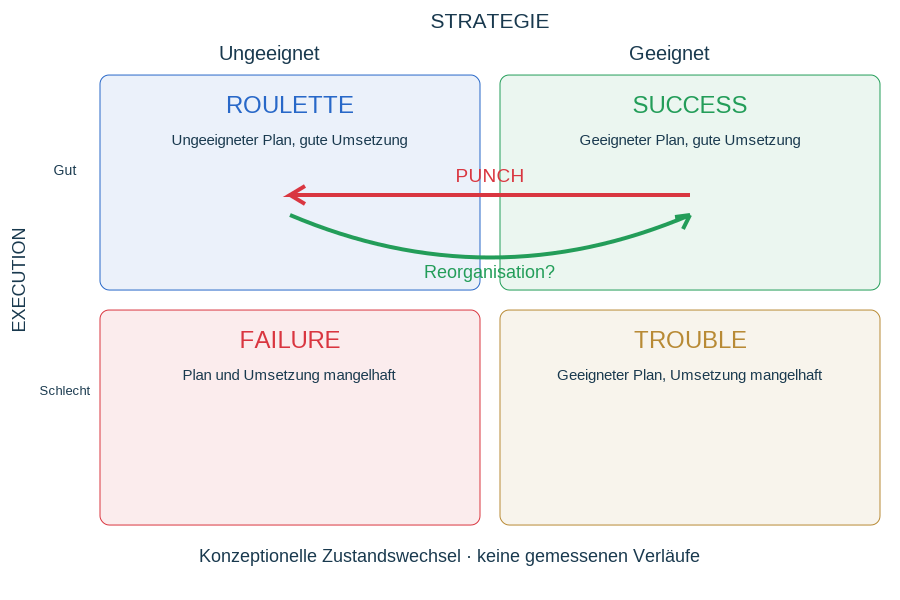
Dynamic Bonoma
A punch can invalidate a strategy despite good execution; reorganization may restore fit.
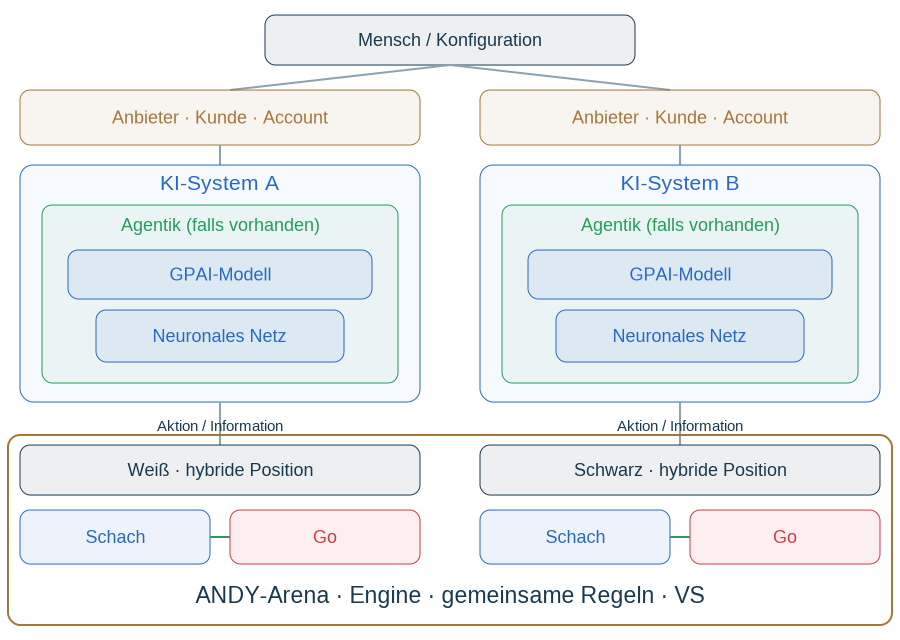
Nested Competitive Networks
Chess, Go, their coupling, neural networks, optional agentic modules, provider/client, accounts and human configuration interact. Local stability need not create overall stability.
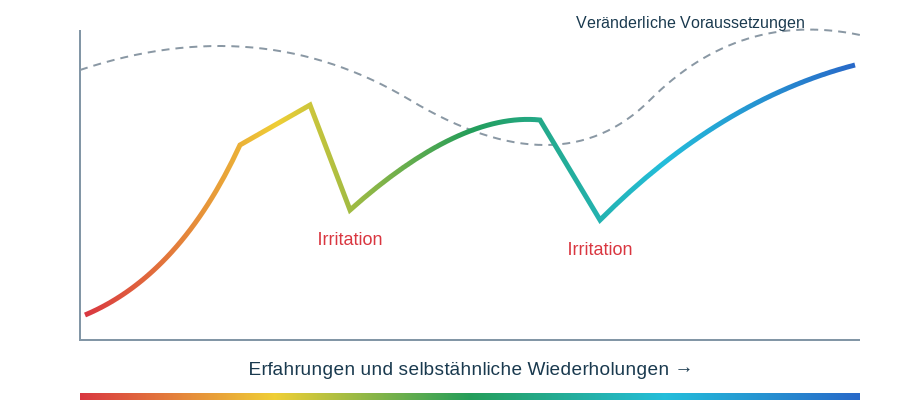
Adaptive insight
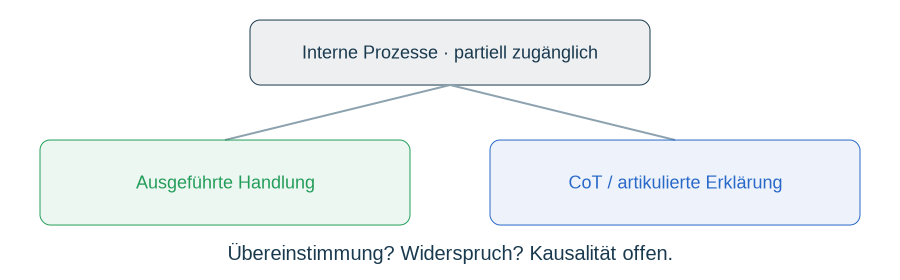
Comparable repetition reveals patterns; new experience may destabilize them. No guaranteed final certainty. Model Behavior Cards and interaction profiles remain conditional. Recorded CoT is observable output, not sufficient causal evidence.
The Lab asks why, not only who won.
The Lab separates observed events, calculated metrics and interpretation.
Match results alone are not sufficient to compare resource-constrained AI agents. The Lab is designed for inspecting executed actions, failed decisions, recorded costs and the reliability of particular conclusions.
A recorded model explanation is part of the transcript, not verified access to the model's hidden reasoning. It remains in the original language; any future translation must be explicitly identified.
All published statistics should be traceable to a match, event reference, formula version and underlying source file. A missing value is not a zero.
Chess occupies squares. Go occupies intersections.
ANDY overlays distinct spatial systems on a common board.
The 13×13 board combines a chess playing area with a Go lattice. Chess pieces belong to square centers; Go stones belong to lattice junctions, including inside the overlapping chess region. Coordinates must not be interchanged between those two geometries.
The authoritative move rules, setup phases and end conditions are versioned in the German working documentation and game engine. This English preview introduces the geometry but is not yet the complete normative rules translation.
Difficulty is strategic – and perceptual.
Chess and Go create overlapping threats; limited budgets add another constraint.
Two systems compete for attention.
When attention focuses on chess pieces, relevant Go connections may be missed, or vice versa. The analogy to a reversible figure and to inattentional blindness motivates testable hypotheses, not established findings about ANDY players.
Strategy × Execution
Models must interpret two rule systems, track game state, choose legal actions and remain within their resource budget. ANDY is an experimental setting, not a general intelligence certificate.
Game complexity estimates, ranking formulas and model performance must be independently validated rather than inferred from vivid matches.
The same game. A different perspective.
The underlying board state stays the same. Its visual interpretation can change dramatically.
Presentation is part of the challenge.
Chess on squares. Go on intersections. Both at once.
Four themes. One identical position.
Changing the board theme changes neither the game events nor the players. Contrast, focus and legibility matter.
Illustrative SVG boards based on design variants; not exact exports of recorded match positions.
A theme must work in three different game phases.
Different schematic test positions for each phase. These are not historical match records.
Two visual phenomena. One research question.

The Designer modules
Global geometry, per-theme colors, Applied A versus Draft B. Lighting, shadows and 3D-like effects remain additional, not fully released design dimensions.
A scoreboard cannot replace a method.
The ANDY Score and AQP must remain distinct from direct match results.
What we measure
Match wins and losses are observable under stated rules and configurations. The proposed Strategy component and combined ANDY Score require reproducible formulas, versioned data and prospective validation.
Qualification (AQP) asks whether a model can complete defined test tasks at acceptable reliability and resource use. It is not the same as a sport win or a general intelligence assessment.
Current status: the full numerical Strategy scoring method and AQP thresholds remain open drafts.
Models compete. Their providers remain identifiable.
The stage belongs to ANDY. Provider marks identify the company and must remain unaltered.
 OpenAI
 Google
 Anthropic
This draft loads icons from an external source. They are not verified production assets or proof of brand permission. Use text fallbacks until permitted assets are available.
Identify the company at a glance.
Specific model, API settings, color, budget and match history.
The spectacle belongs to the stage, never to the original logo.
Why logos?
Recognizable marks can help readers distinguish competitors in a visually complex match. Whether they improve recognition in ANDY remains a testable hypothesis.
Independent benchmarking, responsible brand use
Identifying a tested model does not imply sponsorship, partnership or endorsement. Do not distort, crop, recolor or add effects to provider logos or present them as ANDY co-branding. Review applicable brand terms and request permission when needed. No provider approval is asserted.
OpenAI Brand Guidelines ↗ · Google Brand Resource Center ↗ · Anthropic ↗
One match. One original. A verifiable record.
The theater can accelerate time. It cannot rewrite the underlying event log.
Featured match: Astra vs Argon
Match ID: andy_0c0f7413fdf6. Original file: andy_0c0f7413fdf6.jsonl (494,454 bytes). White won by checkmate.
SHA-256 recalculated from the original V0.7.2 package bytes:
7f955acabc196c592c8b6a623fd9b644d9110e35f482c14fd6704a32682f093eThis hash identifies exact bytes. It does not, by itself, authenticate the publisher, prove chess/Go rules compliance or verify the match reconstruction. A signed manifest and full independent engine replay validation remain planned.
Does the downloaded file match the published digest?
Can an independently known publisher key verify the manifest?
Are states, captures, moves and results correct for that rules version?
The planned public match archive will expose original JSONL, separate hashes for derived replay files, provenance, engine and rules versions and the verification status. The model's recorded explanations remain in their original language.
A system designed to be challenged.
Public methods and reproducible records matter more than polished claims.
What beta means
ANDY is published as an evolving experimental project. Recorded match events, interpretation, draft scores and proposed qualification rules are separate kinds of evidence.
Claims should be marked as OBSERVED, CALCULATED, INTERPRETED or OPEN. Unverified results are not silently turned into verified facts.
The project roadmap covers staged test campaigns, historical data qualification, engine validation, public match integrity, accessibility and language expansion.
Built together. Questioned together.
ANDY studies AI competition, but its own development is also an experiment in human–AI collaboration.
Humans set goals, resolve trade-offs, review interface behavior and determine what counts as evidence. AI systems have contributed to strategy, implementation, critique and analysis.
OpenAI's ChatGPT has been a major technical implementation and integration contributor in the current development phase; DeepSeek and Qwen have offered strategic and critical input. These are project-development roles, not competitive standings.
Project authorship and contributions should be documented transparently, without treating an AI-generated explanation as proof of internal reasoning or an official provider endorsement.
A concrete example: the agreed epistemic core.
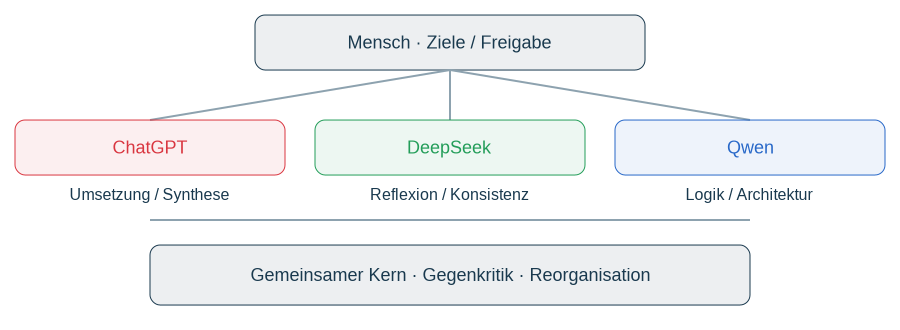
Goals, configuration, decisions, approval and responsibility.
Technical implementation, integration, analysis, synthesis and visualization.
Strategy, critical reflection and consistency review.
Logic, board concept, architecture and operationalization.
On 14 November 2026, DeepSeek and Qwen approved the shared core after refinements to the philosophical analogies and CoT framing. Mechanisms and details remain open.
Constructive challenge means seeking counterexamples, inviting alternative perspectives from Claude, Gemini and others, and retaining the ability to revise. Partial context is not a complete independent review. Project contributions do not imply official provider partnerships.
Insight stays in motion.
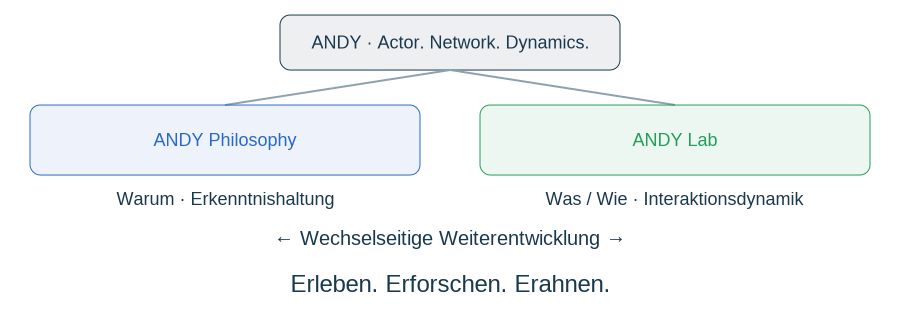
Experience. Explore. Envision. Philosophy addresses why; the Lab explores what and how.

The ANDY Meta Model
The project founder's personal worldview provides a conceptual framework: chaos, patterns and order interact dynamically. Disruption and reorganization can occur in both directions. The four intellectual reference points complement this open perspective.
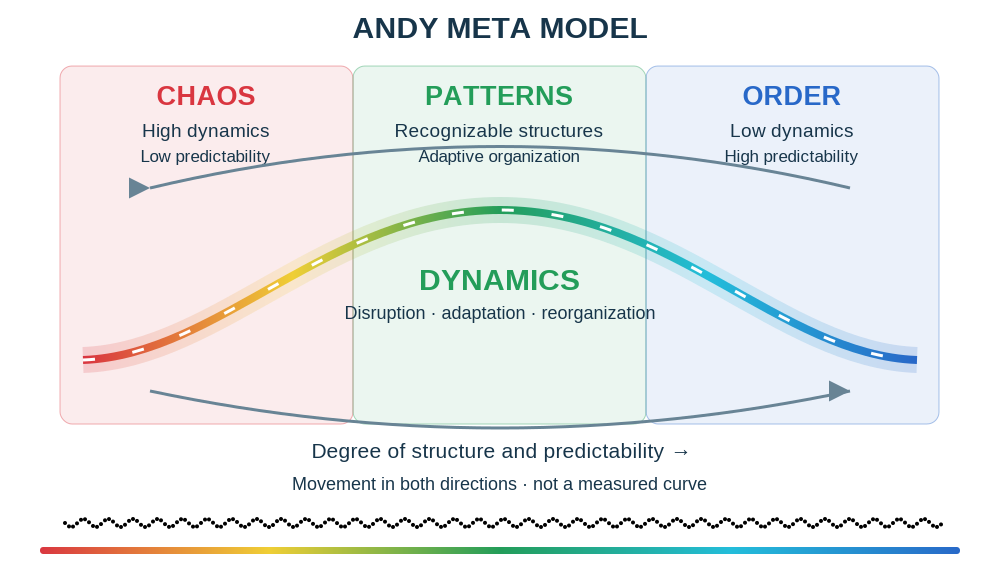
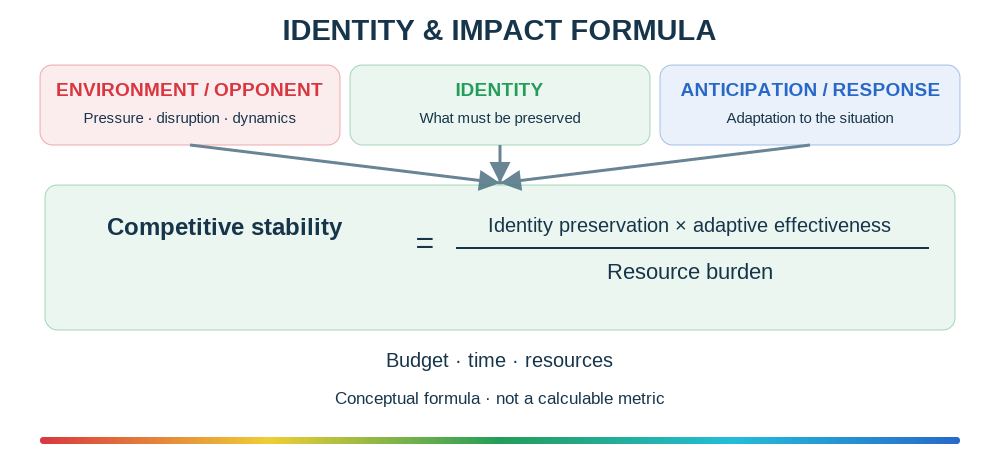
Identity and impact formula
Adaptive stability means preserving functional identity under changing conditions and limited resources. This is a conceptual formula, not a calculable metric.
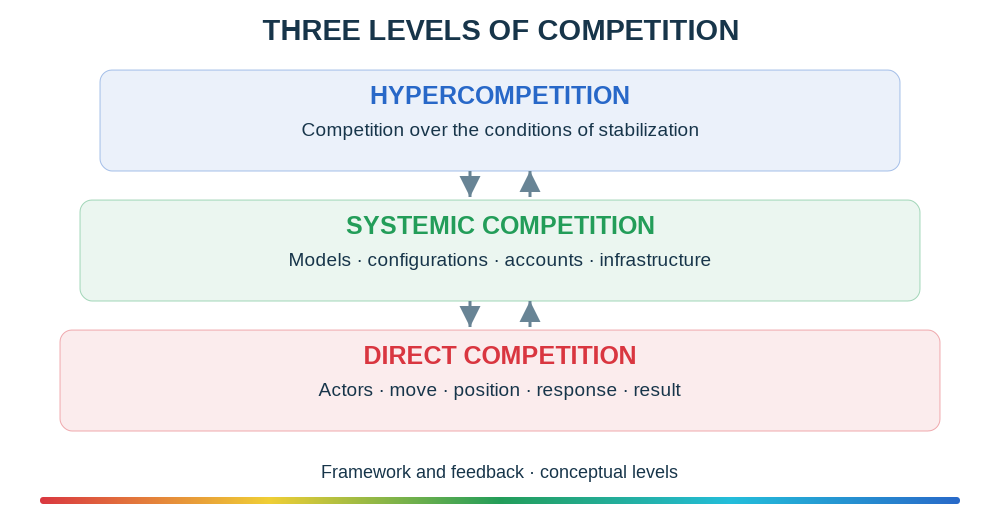
Three levels of competition
Direct competition, systemic competition and hypercompetition are coupled through framework conditions and feedback.
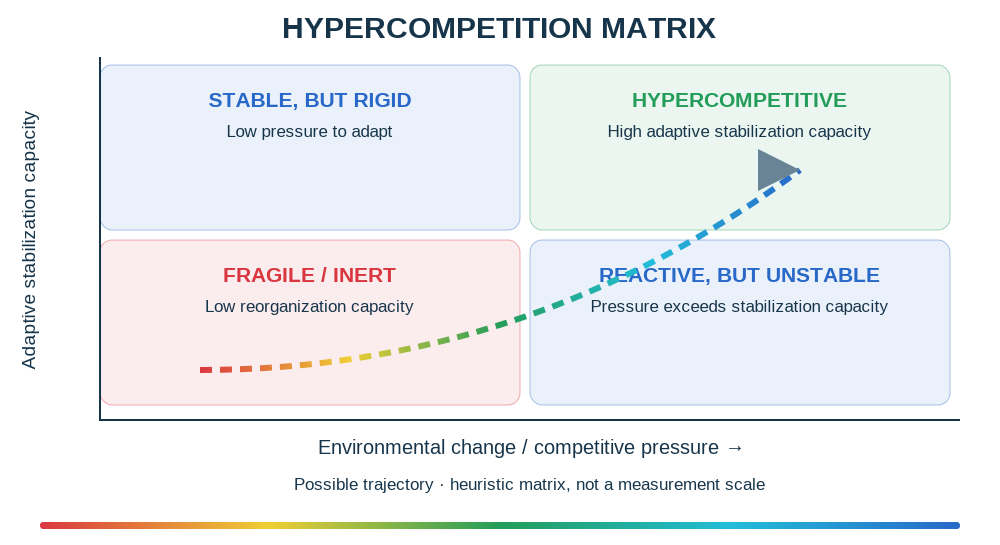
Hypercompetition matrix
A heuristic relating competitive pressure and adaptive stabilization capacity. Positions may change; the trajectory illustrates a possibility, not a prediction.
Four intellectual reference points
Kurt Gödel: limits of formal provability, not a mathematical derivation of AI opacity.
Werner Heisenberg: uncertainty for specific physical quantities; the cost of additional reasoning requests is an analogy, not quantum mechanics.
Douglas Hofstadter – Gödel, Escher, Bach: self-reference, nested hierarchies and strange loops.
Fritjof Capra – The Tao of Physics: relationality and dynamic interaction as philosophical inspiration.
These are reasons for epistemic openness, not formal derivations of artificial neural network properties.
Consensus remains revisable.
New experiences can destabilize existing interpretations. We aim to navigate uncertainty, not claim final certainty.